


From the calendar desk
US vs Canada Holidays 2026: Planning a Trip From the US to Canada
If you live in the United States and are planning a trip to Canada in 2026, the two calendars do not always line up. Some holidays fall on the same date. Others are weeks apart. That difference affects border traffic, hotel prices, long weekends and whether offices or attractions are open on both sides of the border. This guide is written for US travellers and planners. It covers how US and Canadian holidays compare in 2026, when Americans typically head north, and how to use both calendars together before you book.
Why Americans Travel to Canada
Most US trips to Canada are still for leisure, visiting friends and relatives, shopping and short cross-border getaways. Business and professional travel also play a role, especially in corridors that link major cities.
Proximity matters. Many trips start from border states such as New York, Michigan and Washington, where a same-day or overnight visit is realistic by car. Air travel into Toronto, Vancouver, Montreal and Calgary supports longer stays.
In recent data, US-resident trips into Canada have shown periods of year-over-year growth even while Canadian travel into the US was weaker. For planners, the practical takeaway is simple: demand and border conditions still follow holiday weekends and seasonal peaks.
When Americans Go North
There is no single “best” month for every trip, but patterns are clear:
Season | What it is good for | Watch for |
|---|---|---|
June–August | Hiking, cities, national parks, festivals | Peak prices and crowds |
May & September | Shoulder-season value, milder weather | Some mountain trails still limited in early May |
October | Fall colour, Canadian Thanksgiving weekend | Busy roads and higher rates near popular fall destinations |
December–March | Skiing, winter cities, northern lights (north) | Cold, shorter daylight outside resort areas |
US long weekends often push short trips into Canada. Memorial Day, Independence Day, Labor Day and the US Thanksgiving period can all affect when people cross and how full popular routes become.
Border Corridors That Matter Most
High-volume routes for US residents include:
New York ↔ Ontario (Niagara / Buffalo area)
Michigan ↔ Ontario (Detroit–Windsor and nearby bridges)
Washington ↔ British Columbia (Seattle–Vancouver corridor)
These crossings matter for holiday planning because a Canadian statutory holiday or a US federal holiday can change wait times, retail hours and whether a “quiet weekday” is actually quiet.
US Holidays vs Canadian Holidays in 2026
A few 2026 dates are especially useful for side-by-side planning:
Holiday | United States (2026) | Canada (2026) |
|---|---|---|
Independence Day / Canada Day | Independence Day observed Friday, 3 July | Canada Day Wednesday, 1 July |
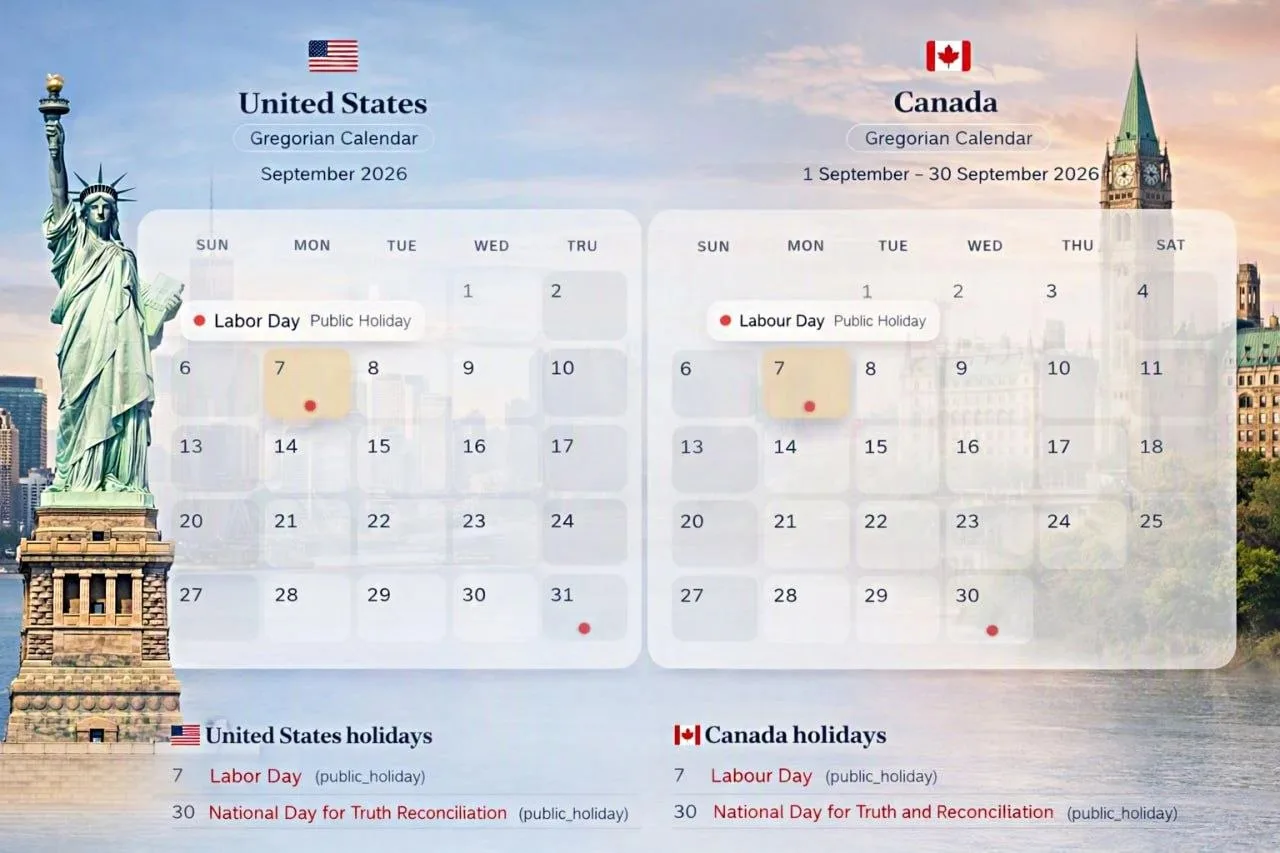
Labor / Labour Day | Monday, 7 September | Monday, 7 September |
Thanksgiving | Thursday, 26 November | Monday, 12 October |
Christmas | Friday, 25 December | Friday, 25 December |
Labour / Labor Day falls on the same Monday in both countries. That can make cross-border coordination simpler for families and teams that span the border.
Thanksgiving is the opposite case. Canadian Thanksgiving is in mid-October; US Thanksgiving is in late November. If you only check the US calendar, you can miss a busy Canadian long weekend in October — or plan a November trip when Canada is already past its Thanksgiving peak.
Dual Citizenship and Family Ties
A growing number of Americans have family links to Canada, and recent citizenship-by-descent changes in Canada have increased public interest in dual status. For many people this is about identity and options, not an immediate move.
Even without dual citizenship, family visits remain a steady reason for US–Canada trips. Those trips often cluster around school breaks and long weekends, which is another reason the two holiday calendars matter.
Planning a Trip Around Both Calendars
Before you lock flights or a hotel:
Check whether your travel dates hit a US federal holiday, a Canadian statutory holiday, or both.
Remember that a US federal holiday is not automatically a paid day off for every private-sector worker.
In Canada, statutory holidays vary by province and by whether a workplace is federally or provincially regulated.
Same-date holidays (like Labour/Labor Day 2026) can be easier for joint plans.
Offset holidays (like the two Thanksgivings) change crowds, rates and opening hours on different weekends.
This is exactly where a side-by-side calendar helps more than a single-country list.
How to Use MultiCalendar for US → Canada Plans
Compare the two countries on one screen, then test leave combinations if you are using PTO:
Use the Compare view to spot overlapping long weekends. Use the Vacation Planner if you need to stretch a few PTO days around a border trip.
FAQ
Is Labor Day the same date in the US and Canada in 2026?
Yes. Both fall on Monday, 7 September 2026.
When is Canadian Thanksgiving in 2026?
Monday, 12 October 2026 — about six weeks before US Thanksgiving on 26 November.
Do I need a visa to visit Canada as a US citizen?
For short visits, US citizens generally enter with a valid passport (and other entry rules as applicable). Always check official CBSA / IRCC guidance before travel.
Which months are busiest for US travel into Canada?
Summer is the broad peak for leisure travel. US long weekends and Canadian fall holidays can create additional spikes on specific corridors.
Why compare both calendars instead of only Canada’s?
Because your time off is often based on the US calendar, while shops, roads and attractions in Canada follow Canadian holidays. The mismatch is where plans break.
The Bottom Line
For Americans heading to Canada in 2026, the useful question is not only “What is closed in Canada?” but “How do US and Canadian holidays interact on my dates?”
Same-date holidays can simplify a cross-border plan. Offset holidays — especially the two Thanksgivings — can change crowds and costs. Putting both calendars side by side is the fastest way to see those gaps before you book.