


From the calendar desk
Canada vs US Vacation Days and Holidays in 2026: What Workers and Travellers Should Know
If you work in Canada, travel between Canada and the US, or plan time off across the border, the two calendars do not line up the way many people expect. Canada has statutory vacation rules that vary by province and jurisdiction. The US has no federal minimum for paid vacation in the private sector. Public holidays are also treated differently in each country. This guide explains how vacation and holidays work in Canada compared with the US in 2026, and why comparing both calendars side by side matters for travel, work and planning.
Canada vs US at a Glance
Canada | United States | |
|---|---|---|
Vacation entitlement | Set by provincial or federal employment standards | No federal statutory minimum for private-sector workers |
Common terms | Vacation time / vacation pay | PTO / vacation days |
Public holidays | Statutory holidays (vary by province) | Federal holidays |
Key complication | Rules differ by province and jurisdiction | Employer policy mainly decides what you get |
Best planning approach | Check your province + the calendar | Check your employer policy + the calendar |
How Vacation Works in Canada
Canada does not have one single national vacation rule for every worker.
Most employees are covered by provincial employment standards. Federally regulated workers (such as those in banking, airlines or interprovincial transport) follow the Canada Labour Code instead.
In general:
Many provinces start with a minimum of 2 weeks of vacation time after one year of service
This often increases to 3 weeks after five years
Federally regulated employees are covered by separate vacation rules under the Canada Labour Code, with entitlement increasing with length of service
The exact entitlement depends on where you work and how long you have been with your employer. Always check the rules that apply to your province or federal status.
Vacation Time vs Vacation Pay
This is one of the most useful distinctions for Canadian workers.
Vacation time is the actual time you are away from work.
Vacation pay is the money you receive for that time.
Vacation pay is calculated according to the employment standards that apply to you. The percentage can vary depending on the province, territory or federal jurisdiction. For example, in Ontario it is commonly 4% for two weeks and 6% for three weeks, but other jurisdictions may differ.
Understanding both helps you plan more accurately, especially if you cash out vacation or receive vacation pay on each paycheque.
Canadian Statutory Holidays vs US Federal Holidays
In Canada, statutory holidays are set by employment standards. Depending on the jurisdiction, eligible employees may receive a paid day off, alternative holiday arrangements, or additional pay when they work the holiday.
In the US, federal holidays apply mainly to the federal government. Private employers are not required by federal law to give paid time off on those dates. Many do, but it depends on company policy.
This difference matters when you are coordinating schedules across the border.
Planning Travel, Work or Business Between Canada and the US
Comparing the two calendars is useful for more than just booking vacation.
A statutory holiday in Canada may be a normal working day in the US
A US federal holiday may not affect private-sector workplaces the same way
Overlapping holidays can affect flight prices, hotel availability and border wait times
For business travel, knowing which days both sides are off helps with meeting planning
For people relocating or working across both countries, the holiday patterns affect how time off is used
Looking at both calendars together gives a clearer picture than checking only one side.
Long Weekends and Coordinating Time Off in 2026
Some 2026 dates are especially useful for planning:
Canada
Canada Day — Wednesday, 1 July 2026
Labour Day — Monday, 7 September 2026
Thanksgiving — Monday, 12 October 2026
Family Day (in several provinces) — Monday, 16 February 2026
United States
Independence Day observed — Friday, 3 July 2026
Labor Day — Monday, 7 September 2026
Thanksgiving — Thursday, 26 November 2026
When a holiday falls next to a weekend, a small number of vacation days can create a longer continuous break.
Labour Day example
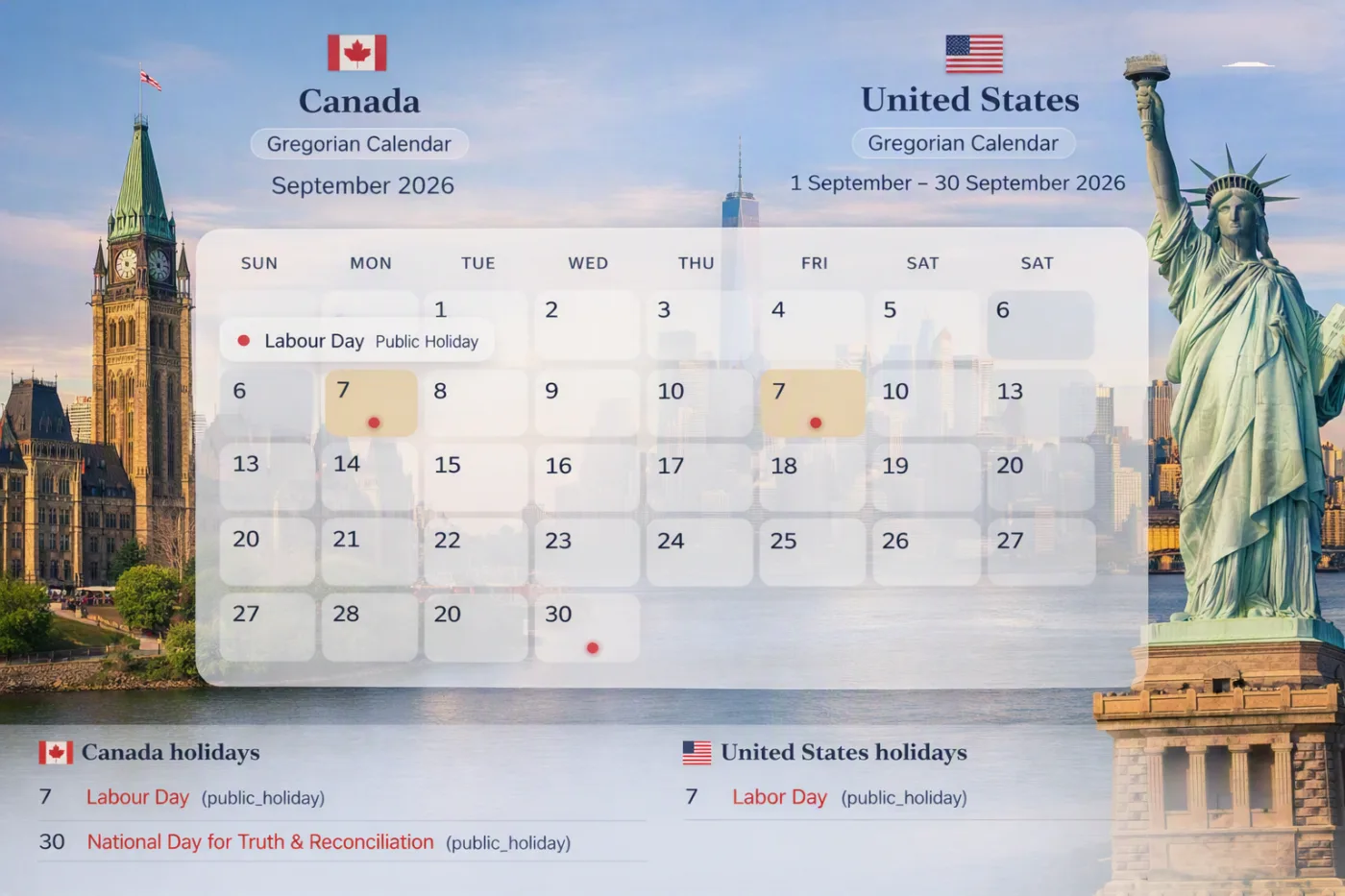
Labour Day falls on Monday, 7 September 2026 in both Canada and the US. If your employer gives you the holiday off, adding Friday, 4 September as a vacation day can create a four-day break. When a holiday lands on the same date in both countries, planning is simpler. When the dates differ, the difference can matter for cross-border travel and business schedules.
Canada vs US Thanksgiving
Canadian Thanksgiving is on Monday, 12 October 2026.
US Thanksgiving is on Thursday, 26 November 2026.
This is one of the clearest calendar differences between the two countries. The earlier Canadian date can affect fall travel plans, family visits and cross-border schedules in ways that are easy to miss if you only check one calendar.
Why Some Holidays Look Similar but Are Not the Same
Canada and the US share some holiday names and traditions, but the dates and rules often differ.
Thanksgiving is earlier in Canada than in the US
Canada Day and Independence Day fall close together in early July but celebrate different events
Family Day exists in several Canadian provinces but is not a US federal holiday
Victoria Day in Canada and Memorial Day in the US both fall in late May but have different meanings
These differences are easy to miss if you only look at one calendar.
How to Compare the Two Calendars
Instead of checking dates one by one, you can view both countries side by side.
Use MultiCalendar’s Canada vs US Compare tool to see overlapping holidays, long weekends and working-day differences at a glance.
You can also use the Vacation Planner to test how many days off you can create with a set number of vacation days:
FAQ
How many vacation days do Canadians get?
It depends on the province or federal rules that apply to your job. Many workers start with a minimum of two weeks after one year, increasing with longer service.
Is vacation pay the same as vacation time?
No. Vacation time is the time off. Vacation pay is the money paid for that time, calculated according to the rules that apply in your jurisdiction.
Do Canadian statutory holidays vary by province?
Yes. Some holidays are shared across the country, while others apply only in certain provinces or to federally regulated workplaces.
Does the US guarantee paid vacation?
No. There is no federal statutory minimum for paid vacation for private-sector workers. Benefits are generally set by the employer.
Why should I compare Canada and US calendars?
Because holidays, long weekends and working days do not always line up. Comparing both helps with travel, work schedules and time-off planning.
The Bottom Line
Canada and the US handle vacation and public holidays differently. Canada generally provides clearer legal minimums, but the rules depend on where you work. The US leaves more to employer policy.
For anyone planning time off, travel or work between the two countries, the most useful step is to look at both calendars together. That is the fastest way to spot long weekends, overlapping holidays and the best dates to use your vacation days in 2026.